
If you are trying to understand Canada tobacco products, it helps to begin with product categories rather than individual brands. Cigarettes may be the most familiar format, but Canada’s tobacco market also includes cigars, little cigars, cigarette tobacco, pipe tobacco, chewing tobacco, snuff, water-pipe tobacco, and certain tobacco products designed for use with devices.
For more information about Canadian tobacco categories, brands, and related terminology, explore the tobacco resources available at CheapSmokes
This guide looks specifically at how different tobacco products are categorized and how their formats differ. That distinction is useful because Canadian regulations do not treat every tobacco product in exactly the same way.
What Types of Tobacco Products Are Available in Canada?
When discussing Canada tobacco products, cigarettes are only one category within a much broader regulatory framework.
Health Canada’s current tobacco labelling system separately addresses cigarettes; little cigars, cigarette tobacco and tubes; cigars; pipe tobacco; chewing tobacco and snuff; water-pipe tobacco; and tobacco products intended for use with devices. These categories are useful because they show how federal regulators distinguish tobacco formats when setting packaging and health-warning requirements. ([Health Canada, 2026])
Cigarettes
Cigarettes remain one of the most recognizable tobacco formats. Under federal regulations, a cigarette generally means a tobacco-containing roll or tubular construction intended for smoking that does not meet the definitions of a cigar, little cigar, or tobacco stick. ([Department of Justice Canada, 2026])
Federal law also specifies that cigarettes sold in Canada generally cannot be packaged in quantities of fewer than 20 units. The same minimum applies to little cigars and blunt wraps. ([Department of Justice Canada, 2026])
Cigars and Little Cigars
Cigars form another distinct category. Canadian regulations generally define a cigar as a roll or tubular construction intended for smoking that contains natural or reconstituted tobacco filler and a tobacco-based wrapper or wrapper-and-binder combination.
Little cigars are classified separately. Under the Tobacco and Vaping Products Act, they include tobacco rolls intended for smoking that meet specific construction requirements and either have a cigarette filter or weigh no more than 1.4 grams, excluding a mouthpiece or tip. ([Department of Justice Canada, 2026])
Loose and Pipe Tobacco
Canada tobacco products also include cigarette tobacco used for roll-your-own applications and tobacco prepared for pipes. These formats differ from manufactured cigarettes because the tobacco and the final smoking format are not necessarily sold as one finished unit.
Smokeless Tobacco
Chewing tobacco and snuff belong to the smokeless tobacco category. Unlike cigarettes or cigars, these products are used without combustion. However, Health Canada notes that smokeless tobacco still contains harmful and addictive substances and is associated with risks including cancers of the mouth and throat and serious dental problems. ([Health Canada, 2026])
Looking for popular Canadian tobacco products? Explore our Best Sellers collection to see customer-favourite options available at CheapSmokes.

How Are Tobacco Products Classified in Canada?
Canada’s tobacco classification system is based largely on product construction, tobacco content, intended method of use, and regulatory definition.
The Tobacco and Vaping Products Act defines a tobacco product broadly as a product made wholly or partly from tobacco, including tobacco leaves. The definition can also include papers, filters, tubes, certain necessary devices, and parts used with those devices. ([Department of Justice Canada, 2026])
This means Canada tobacco products can be organized into several practical groups:
| Category | Typical Format | Method of Use |
|---|---|---|
| Cigarettes | Manufactured tobacco roll | Combustion |
| Little cigars | Small wrapped tobacco roll | Combustion |
| Cigars | Tobacco filler with tobacco wrapper | Combustion |
| Cigarette tobacco | Loose tobacco | Usually rolled before use |
| Pipe tobacco | Loose prepared tobacco | Smoked in a pipe |
| Water-pipe tobacco | Prepared tobacco | Used with a water pipe |
| Chewing tobacco | Loose or compressed tobacco | Oral use |
| Snuff | Finely processed tobacco | Oral or nasal format depending on type |
| Device-related tobacco | Processed tobacco designed for a device | Product-specific |
Importantly, vaping products are not automatically classified as tobacco products simply because they contain nicotine. Canada’s legislation provides separate legal definitions for tobacco products and vaping products. ([Department of Justice Canada, 2026])
Understanding those distinctions is important when comparing Canadian products because packaging, labelling, product construction, and other regulatory requirements may vary according to category.
What Makes Canadian Tobacco Products Different?
One of the clearest differences between Canadian tobacco products and products sold in many other markets is their heavily standardized presentation.
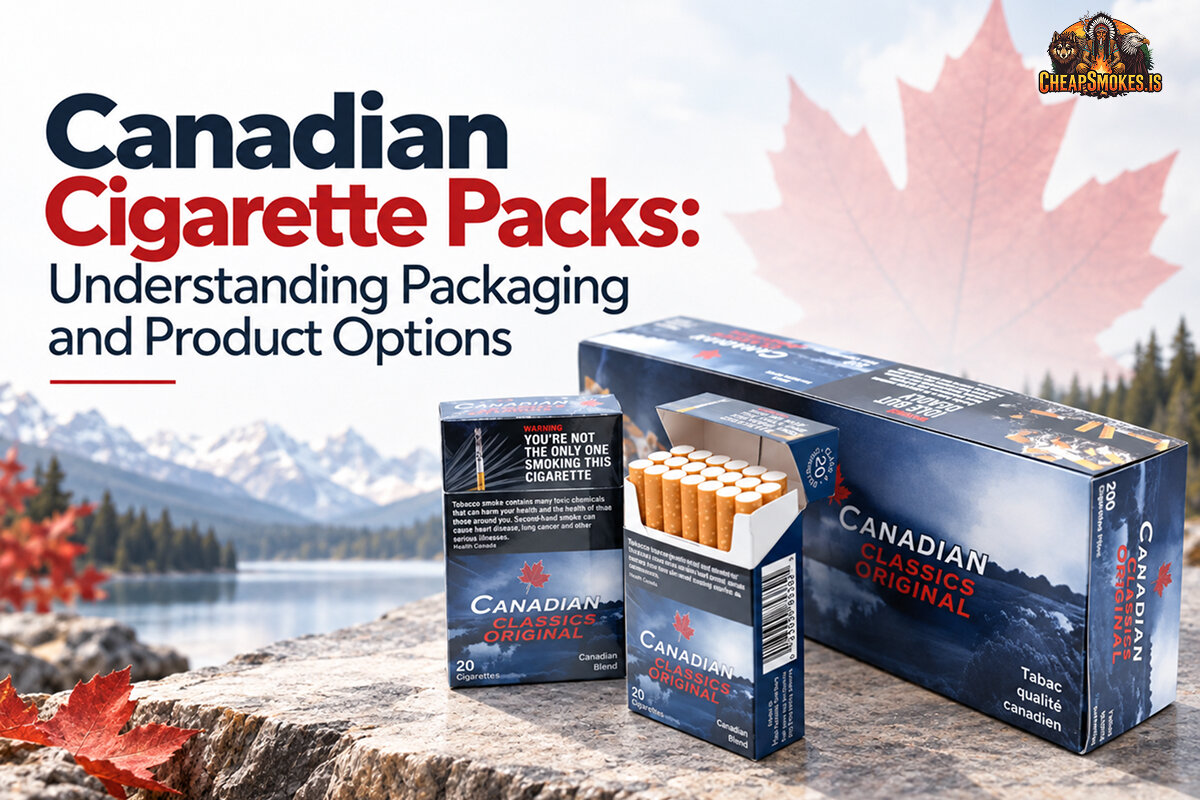
Canada’s Tobacco Products Appearance, Packaging and Labelling Regulations establish health-warning, toxicity-information, and appearance requirements across tobacco categories. Health warnings must cover at least 75% of the primary display area of most packages, while toxicity information must appear on the exterior of tobacco packaging. ([Health Canada, 2026])
Certain Canada tobacco products are also subject to warnings directly on the product itself. Cigarettes, little cigars with tipping paper, and tubes fall within the current on-product warning framework. This makes the Canadian system particularly distinctive because warnings are no longer limited to outer packaging. ([Health Canada, 2026])
The regulations also use rotating health-warning systems. Depending on the product category, health-related messages are rotated on schedules ranging from approximately 24 to 36 months. This approach is intended to prevent consumers from repeatedly seeing exactly the same warning material over long periods. ([Health Canada, 2026])
Canadian rules also restrict certain promotional terminology. Health Canada’s regulatory overview notes that terms such as “light” and “mild,” including variations of those expressions, are prohibited for several tobacco categories and their packaging, promotion, advertising, and retail displays. ([Health Canada, 2026])
As a result, differences among Canadian tobacco products are often found more in format, tobacco blend, construction, dimensions, processing, and intended method of use than in highly differentiated package design.
Which Tobacco Products Are Commonly Preferred in Canada?
It is difficult to identify a single nationally “preferred” product using retailer listings or anecdotal popularity. Official survey data provides a more reliable way to understand relative use across product categories.
Health Canada’s 2022 Canadian Tobacco and Nicotine Survey reported that 12.9% of Canadians aged 15 and older had used at least one tobacco product during the previous 30 days. The survey included cigarettes, little cigars or cigarillos, cigars, pipes, chewing tobacco, and water-pipe tobacco. ([Health Canada – Canadian Tobacco and Nicotine Survey, 2022])
Cigarette smoking was considerably more common than the other individual categories measured. Current cigarette smoking was reported by 10.9% of Canadians aged 15 and older in the survey. By comparison, 2.4% reported smoking any type of cigar during the previous 30 days, while 1.7% specifically reported little cigars or cigarillos. ([Health Canada – Canadian Tobacco and Nicotine Survey, 2022])
Less common categories included traditional pipe tobacco, reported by 0.3% of respondents; chewing tobacco, reported by 0.6%; and water-pipe tobacco, also reported by 0.6%. These figures suggest that cigarettes accounted for a substantially larger share of reported tobacco use than these alternative formats within that survey. ([Health Canada – Canadian Tobacco and Nicotine Survey, 2022])
However, these numbers should not be interpreted as a current product sales ranking. Surveys measure reported use, while retail sales can vary by province, age group, retailer, product availability, taxation, and other factors.
Therefore, when discussing preferences among Canada tobacco products, it is more accurate to say that cigarettes have historically shown higher reported use than cigars, pipes, chewing tobacco, and water-pipe tobacco rather than claiming that a particular product or brand is Canada’s “best seller.”

How Should Consumers Understand Different Tobacco Options?
For adult consumers researching tobacco categories, the easiest approach is to compare products by format instead of relying only on brand names.
Start with the method of use. Cigarettes, cigars, pipes, and water-pipe tobacco involve combustion. Chewing tobacco and snuff do not rely on burning. Other tobacco products may be designed for use with a specific device.
Next, consider how the product is constructed. A manufactured cigarette is fundamentally different from loose cigarette tobacco, even though both can involve similar tobacco leaf materials. Likewise, little cigars and conventional cigars may look related but are legally distinguished according to characteristics such as construction, weight, and filter design.
Packaging is another useful indicator. Different Canada tobacco products can carry category-specific health warnings and toxicity information. Health Canada’s current system includes separate warning materials for cigarettes, cigars, pipe tobacco, chewing tobacco and snuff, water-pipe tobacco, and other product categories. ([Health Canada, 2026])
Finally, product differences should not be confused with differences in safety. Health Canada states that smokeless tobacco contains harmful and addictive substances, while combustible products expose users to toxic tobacco smoke. Different formats create different exposure patterns, but no tobacco category should be interpreted as harmless simply because its construction or use differs from cigarettes. ([Health Canada, 2026])
For readers researching Canada tobacco products, understanding these structural differences provides a much clearer picture than comparing package appearance or marketing terminology alone.
Interested in exploring more about Canadian tobacco products? Check out our Tobacco Canada guide for a broader overview of tobacco categories, brands, regulations, and market information.
FAQs About Canada Tobacco Products
What are the main tobacco product categories in Canada?
Major categories include cigarettes, cigars, little cigars, cigarette tobacco, pipe tobacco, chewing tobacco, snuff, water-pipe tobacco, and tobacco products intended for use with certain devices. Health Canada’s current labelling framework recognizes these as separate or grouped regulatory categories. ([Health Canada, 2026])
Are cigars and little cigars considered the same product?
No. Canadian legislation distinguishes little cigars from other cigars based on factors including construction, filter design, and weight. ([Department of Justice Canada, 2026])
Are vaping products classified as tobacco products in Canada?
Not automatically. The Tobacco and Vaping Products Act contains separate definitions for vaping products and tobacco products. A nicotine-containing vaping product is therefore not simply classified as tobacco because it contains nicotine. ([Department of Justice Canada, 2026])
Which tobacco format is most commonly used in Canada?
In Health Canada’s 2022 CTNS data, cigarette smoking was reported substantially more often than cigar, pipe, chewing tobacco, or water-pipe tobacco use. This describes reported usage, however, and should not be treated as a brand or retail sales ranking. ([Health Canada – Canadian Tobacco and Nicotine Survey, 2022])
Do all tobacco products carry the same warnings?
No. Canada’s labelling system contains category-specific warning materials, although most tobacco packages are subject to major health-warning and toxicity-information requirements. ([Health Canada, 2026])
Final Thoughts on Canada Tobacco Products
Understanding Canada tobacco products becomes much easier once you separate them by construction and method of use. Cigarettes, cigars, loose tobacco, pipe tobacco, smokeless products, water-pipe tobacco, and device-related tobacco products each occupy distinct positions within Canada’s regulatory framework.
Rather than assuming that every tobacco format is simply a variation of a cigarette, looking at the product category, method of use, labelling requirements, and federal definition provides a more accurate picture of the Canadian market.
If you want to continue learning about Canada tobacco products, Canadian cigarettes, tobacco varieties, and related terminology, visit CheapSmokes for additional guides and product information. Always follow the tobacco laws and minimum-age requirements that apply in your province or territory.
Disclaimer: This content is for informational purposes only and does not encourage tobacco use. Product information, availability, and regulations may vary by location. Always follow applicable laws, age requirements, and local tobacco regulations.












This is a useful overview of the different tobacco products available in Canada. I especially liked how the article explains the differences between the main product categories instead of treating them all the same. It would be interesting to see a more detailed comparison of how these products differ in terms of use and availability.
I found this article pretty easy to follow, especially the breakdown of the different tobacco product types. The information about the Canadian market was also helpful for putting everything into context. Are there any major differences in product availability between provinces?
There’s a lot of helpful information here for anyone who wants to understand the Canadian tobacco market better. I liked that the article covers more than just cigarettes and gives some context around different tobacco products. A follow-up article comparing the most common product categories in Canada would be really interesting.
[…] Explore different tobacco categories available in Canada, including cigarettes, cigars, loose tobacco, and other product types: Canada Tobacco Products: Understanding Available Tobacco Categories […]