
When you search for Prime Time Grape price, you may be looking for more than the current cost of a single pack or carton. Tobacco pricing can be influenced by product quantity, retailer pricing, taxes, shipping, promotions, inventory, and purchasing volume.
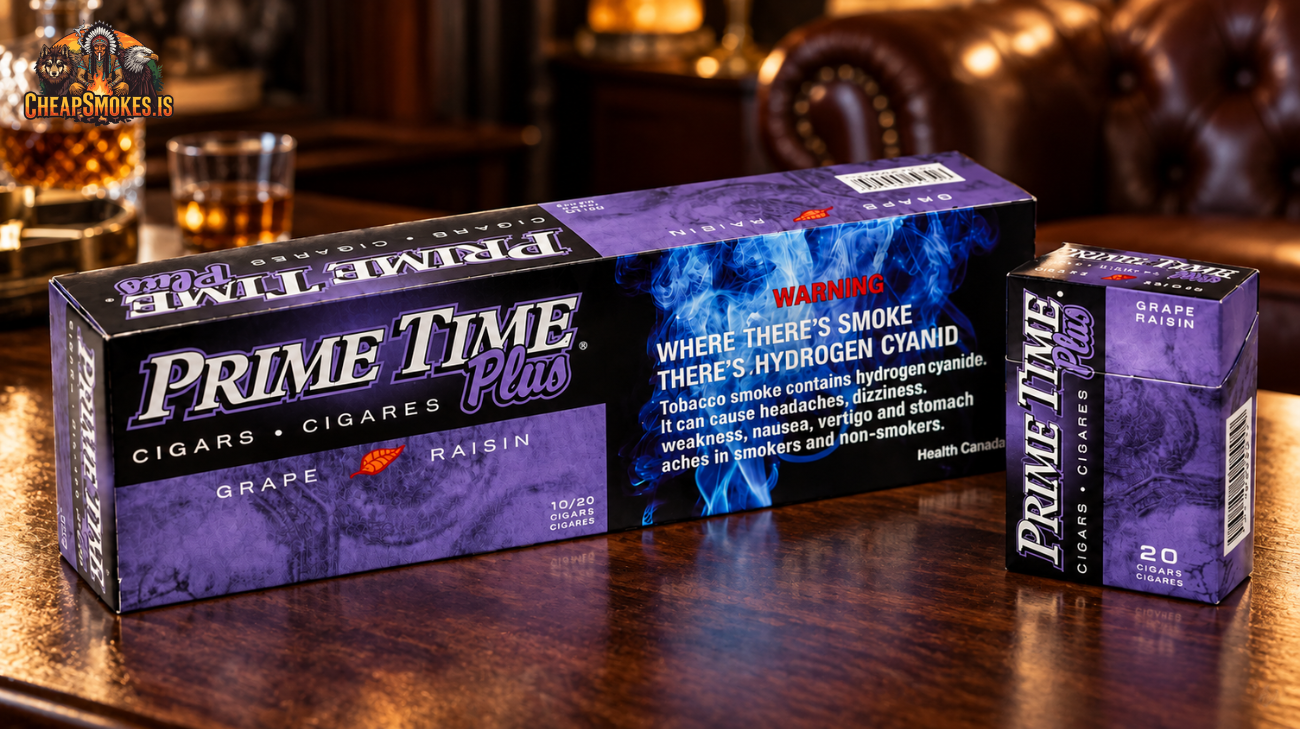
The current CheapSmokes listing for Prime Time Plus Grape shows a price of $50 per carton, with volume pricing of $45 for 5–24 cartons, $40 for 25–49 cartons, and $35 for 50 or more cartons. The listing states that one carton contains 10 packs and 200 king-size cigarettes.
Because tobacco prices can change, a live product page is the most useful reference when checking the current retailer price. In this guide, we will look at the main factors behind Prime Time Grape price, why different sellers may show different prices, and how to compare product value more accurately.
What Factors Influence Prime Time Grape Price?
Several factors can influence the Prime Time Grape price displayed by a retailer. Understanding these factors makes it easier to distinguish the listed product price from the total cost of an order.
Product Quantity
Quantity is one of the simplest factors affecting tobacco pricing. A single pack and a full carton represent different purchasing units, so comparing their prices directly may not provide a meaningful comparison.
The current CheapSmokes listing identifies one carton as 10 packs, containing 200 king-size cigarettes in total. It also offers lower per-carton pricing when larger quantities are purchased.
The current listed pricing structure is:
| Quantity | Listed Price Per Carton |
|---|---|
| 1–4 cartons | $50 |
| 5–24 cartons | $45 |
| 25–49 cartons | $40 |
| 50+ cartons | $35 |
These prices reflect the current product listing and can change as retailer pricing, inventory, or promotions change.
Taxes and Excise Duties
Government taxation is another factor that can affect tobacco pricing in Canada.
The Canada Revenue Agency states that federal excise-duty rates on certain tobacco products are adjusted annually on April 1 based on changes in the Consumer Price Index. For cigarettes, the federal excise-duty rate effective April 1, 2026 is $0.97299 per five cigarettes or fraction of five cigarettes contained in a package. (Canada Revenue Agency, 2026)
These government duties form part of the broader pricing environment for tobacco products, although the final retail price also depends on retailer, distribution, and other applicable costs.
Distribution and Operating Costs
Retailers also have operating expenses associated with inventory management, warehousing, payment processing, customer service, and distribution.
These costs can vary between sellers. As a result, the same tobacco product may appear at different prices depending on the retailer and the commercial conditions under which the product is sold.
Promotions and Volume Pricing
Promotional offers can also change the effective Prime Time Grape price.
For example, the current CheapSmokes listing applies progressively lower prices when customers purchase larger quantities.
When comparing prices, it is therefore useful to distinguish a standard listed price from a temporary promotion or volume-based price.
Explore the Prime Time Plus Grape product page to learn more about its flavor profile, product details, and current availability.
Why Can Prime Time Grape Prices Vary Between Different Sellers?
If you search for Prime Time Grape price across multiple retailers, you may find different prices for what appears to be the same product.
That difference does not necessarily indicate that the products themselves are different. Retailers can have different acquisition costs, operating expenses, inventory levels, pricing strategies, and promotional structures.
Retailer Pricing Strategy
Each retailer establishes its own pricing based on factors such as wholesale acquisition cost, operating expenses, inventory, and desired margins.
A retailer carrying a larger inventory may also use a different pricing structure from a seller with limited stock.
Quantity and Packaging
Another common source of price differences is the purchasing unit.
One website may list an individual pack, while another may list a carton. Comparing the two headline prices without converting them into an equivalent unit can make one offer appear cheaper or more expensive than it actually is.
The CheapSmokes product listing specifies that one Prime Time Grape carton contains 10 packs and 200 king-size cigarettes.
Shipping Costs
The displayed product price may not always represent the final amount paid.
Shipping costs can depend on destination, order size, delivery method, and retailer policy. Therefore, comparing only the product price without considering delivery charges may provide an incomplete picture of total cost.
Promotions
Temporary promotions can also create differences between sellers.
A retailer may offer a discounted price for a limited period or provide volume-based pricing. When comparing Prime Time Grape price, check whether the displayed amount is a regular price, promotional price, or quantity-based price.
Tax Treatment
Federal and provincial taxation can also affect tobacco pricing in Canada.
The federal government publishes tobacco excise-duty rates, while provincial and territorial governments can apply their own tobacco taxes and requirements. Federal rates are periodically adjusted, meaning the tax component of tobacco pricing can change over time. (Canada Revenue Agency, 2026)
How Should Consumers Evaluate Prime Time Grape Product Value?
Looking at Prime Time Grape price alone does not provide a complete picture of product value.
A more useful comparison considers the price together with quantity, product information, retailer transparency, shipping, and the final purchase cost.
Compare Equivalent Quantities
Start by comparing the same purchasing unit.
Comparing the price of one pack from one seller with an entire carton from another seller will not provide an accurate comparison.
Calculate the Unit Cost
Dividing the total price by the number of packs or units provides a clearer basis for comparison.
For example, the current $50 CheapSmokes carton contains 10 packs, giving a simple equivalent of $5 per pack before any additional charges. Larger-volume pricing reduces the listed per-carton cost further.
Check the Final Cost
A low advertised price may not necessarily result in the lowest final purchase cost if additional charges apply.
Before completing an order, review shipping charges, applicable taxes, and any other costs presented by the retailer.
Consider Product Information
Price should also be considered alongside accurate product information.
A useful product listing should clearly identify the product name, format, quantity, current availability, and purchasing options. The current CheapSmokes listing provides these details alongside its pricing structure.
What Should Buyers Consider When Comparing Prime Time Grape Prices?
When comparing Prime Time Grape price, using the same checklist across different retailers can make the comparison clearer.
| Comparison Factor | What to Check |
|---|---|
| Base price | Listed product cost |
| Quantity | Number of packs or units |
| Carton size | Total quantity per carton |
| Bulk pricing | Discounts for larger quantities |
| Shipping | Delivery cost and conditions |
| Taxes | Applicable tax treatment |
| Availability | Current stock status |
| Product information | Format and product specifications |
| Retailer information | Business and customer-service details |
The current CheapSmokes product page provides quantity-based pricing, showing a standard carton price alongside progressively lower prices for larger orders.
Government taxation is another reason tobacco prices can change over time. The Canada Revenue Agency confirms that certain tobacco excise-duty rates are adjusted annually on April 1 based on changes in the Consumer Price Index. (Canada Revenue Agency, 2026)
This means an older article, screenshot, or third-party price comparison may no longer reflect the current Prime Time Grape price.
For retailer-specific pricing, checking the current product page is therefore more reliable than relying on an older price reference.
Explore the Prime Time Plus Grape product page to learn more about its flavor profile, product details, and current availability.

How Can Consumers Find Reliable Information About Prime Time Grape Pricing?
When researching Prime Time Grape price, the first place to check is the current product page of the retailer offering the product.
A useful product page should clearly provide:
-
Product name
-
Current listed price
-
Quantity
-
Available formats
-
Bulk pricing, if applicable
-
Stock status
-
Shipping information
-
Applicable purchasing requirements
The current Prime Time Plus Grape provides the listed price, carton quantity, bulk pricing structure, and stock information.
For broader pricing context, government sources such as the Canada Revenue Agency are useful for understanding federal tobacco taxation and how excise-duty rates change over time. (Canada Revenue Agency, 2026)
It is also important to remember that retailer prices are not necessarily permanent. Inventory levels, promotions, tax adjustments, and pricing strategies can all affect the amount displayed online.
Therefore, if you are specifically researching the current Prime Time Grape price, check the retailer’s live product listing before relying on a historical price.
FAQs About Prime Time Grape Price
How much is Prime Time Grape currently listed for?
The current CheapSmokes product page lists Prime Time Grape at $50 per carton, with lower listed prices for larger quantities.
How many packs are in one Prime Time Grape carton?
The current product listing states that one carton contains 10 packs and 200 king-size cigarettes.
Does Prime Time Grape have bulk pricing?
Yes. The current listing shows prices of $45 for 5–24 cartons, $40 for 25–49 cartons, and $35 for 50 or more cartons.
Why can tobacco prices change over time?
Retail pricing can be affected by taxes, excise-duty adjustments, distribution costs, inventory, promotions, and retailer pricing strategies. Federal tobacco excise-duty rates are adjusted annually for certain tobacco products. (Canada Revenue Agency, 2026)
Should I compare pack or carton prices?
For a meaningful comparison, use the same purchasing unit. If one retailer lists a pack and another lists a carton, calculate the equivalent per-pack or per-carton cost before comparing.
Where can I check the current Prime Time Grape price?
You can check the current price and quantity options directly on the Prime Time Plus Grape.
Final Thoughts on Prime Time Grape Price
Understanding Prime Time Grape price involves more than looking at a single headline number. Quantity, bulk pricing, taxes, retailer costs, shipping, promotions, and inventory can all influence the final cost.
At the time of writing, CheapSmokes lists Prime Time Grape at $50 per carton, with quantity-based pricing available for larger orders. Because retailer prices can change, the live product page remains the most appropriate place to check current pricing and availability.
For current product information, pricing, and available quantity options, visit Prime Time Plus Grape.
For more guides covering Canadian cigarettes, tobacco products, pricing, and product characteristics, explore CheapSmokes
Disclaimer: This content is for informational purposes only and does not encourage tobacco use. Product information, availability, and regulations may vary by location. Always follow applicable laws, age requirements, and local tobacco regulations.














I found this article helpful for understanding the different factors that can affect the price of Prime Time Grape in Canada. The discussion about taxes and regional pricing was particularly interesting. Does the price vary significantly between provinces?
This was an interesting overview of Prime Time Grape pricing, especially the explanation of the factors behind the final price. I liked that the article puts pricing into the broader Canadian market context. It would be useful to see how these prices have changed over the past few years.
I enjoyed reading this because it explains that the price of a tobacco product can be influenced by more than just the product itself. The information about taxes, distribution, and regional differences gives some useful context. Would a comparison of tobacco prices across different Canadian provinces be possible in a future article?